Medical Device Requirement Development & Traceability
Mastering the complex web of user needs, design requirements, verification and validation in modern medical device development.

Tracking hundreds, even thousands of requirements from concept all the way through final V&V can be a total engineering nightmare. But it doesn't have to be. If you start with the right tools, you can keep a clear picture of all the requirements, risks and required testing as the design develops and evolves.
Requirements traceability bridges your technical needs with mandatory regulatory compliance. It ensures not only that a requirement or risk doesn't slip through the cracks, but that you can demonstrate to regulatory authorities and auditors, you were in control through the whole process. Every single user need and design requirement is completely fulfilled, all risks have been mitigated as far as possible and everything is verified and validated. Plus, it keeps your entire project meticulously organized and lets you sleep at night not worrying about what you missed.
What Regulators Want
If you're in medical devices you know meeting regulatory requirements and expectations is the name of the game. You might have the most amazing, life saving product ever, and it's not going anywhere if you don't play by their rules … and that means a lot of meticulous documentation. Requirements are set by two top bodies.
The FDA (21 CFR)
The FDA enforces strict design controls through 21 CFR 820.30. Federal law incorporates quality management standards directly into its rules.
Under 21 CFR 820.30, manufacturers must establish clear relationships between user expectations, product requirements, engineering outputs, and testing protocols. The regulation states:
21 CFR § 820.30(c) Design input. "Each manufacturer shall establish and maintain procedures to ensure that the design requirements relating to a device are appropriate and address the intended use of the device, including the needs of the user and patient."
21 CFR § 820.30(f) Design verification. "Each manufacturer shall establish and maintain procedures for verifying the device design. Design verification shall confirm that the design output meets the design input requirements."
Under this regulation, you must show a clear path from user needs and design requirements to verification and validation testing. At a high level, this might not sound like a big deal, but as you start to develop your concept, the requirements start to grow from 10 to a 100, maybe even thousands, and it quickly becomes a nightmare.
The European Union (ISO 13485)
For global markets, ISO 13485 outlines similar expectations for product realization and design controls. Clause 7.3 governs design and development, explicitly expecting structured data linkages.
Clause 7.3.2 Design and development planning: The organization shall document... the traceability of design and development outputs to design and development inputs.
Requirements Traceability serves as objective evidence of compliance. It documents that design outputs directly answer design inputs, and that those inputs are fully evaluated during verification testing.
Bidirectional Traceability
Traceability must work seamlessly in both directions.
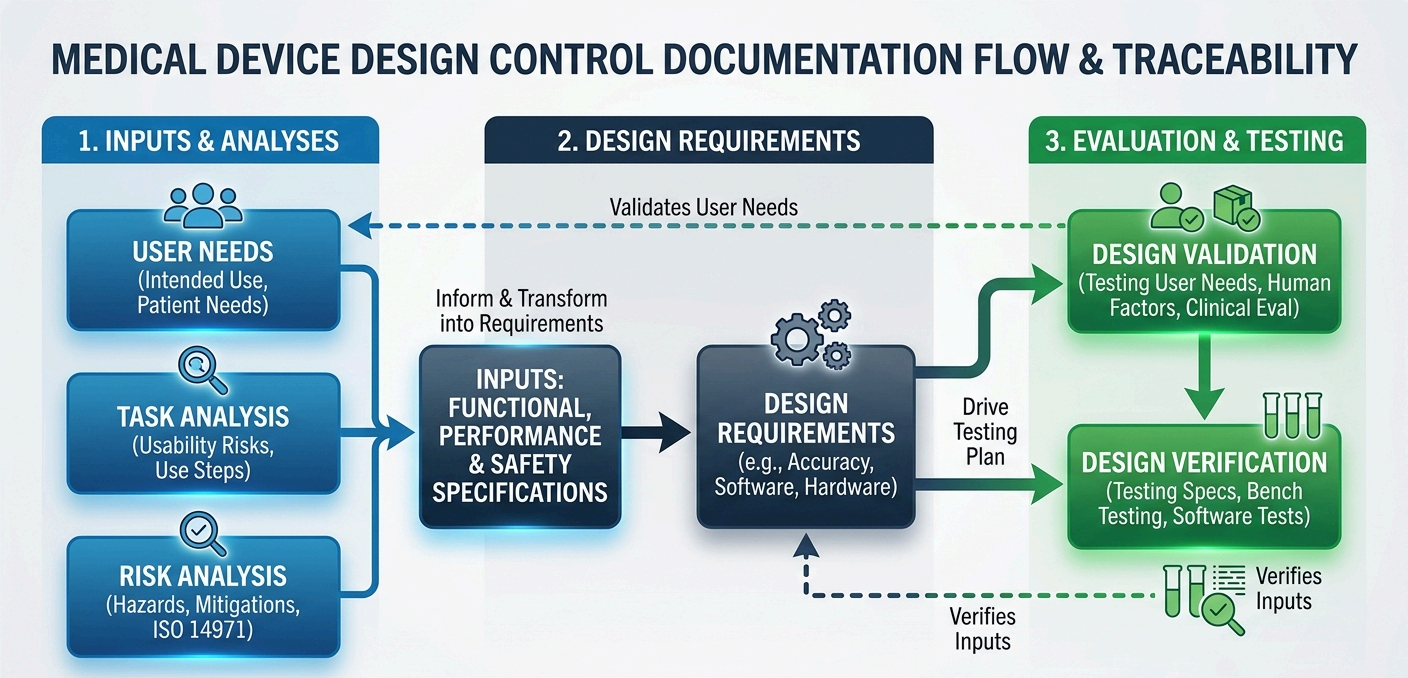
Forward traceability tracks a requirement from inception to final implementation. Project managers use it to verify that:
- User Needs map to at least one Design Input.
- Design Inputs translate into a concrete Design Output (specifications, CAD drawings, software code).
- Design Inputs point to a specific Verification Test Method and Protocol.
Backward traceability starts at the end of the lifecycle and looks in reverse. It is used during audits to trace testing back to its original source and confirm compliance.
Why Spreadsheets Fail
Historically, engineering teams tracked links manually via desktop spreadsheets, but this can quickly become cumbersome and unmanageable and potentially lead to compliance or even product safety and quality risks:
- Broken Data Links: Adding, removing and changing requirements manually, risk breaking relationships. This could result in hidden, untested product features, potentially risking patient safety.
- Productivity Bottlenecks: Engineers spend days manually formatting matrices and cross-checking everything rather than focusing on product development.
- Poor Collaboration: Multiple copies of spreadsheets circulating across teams cause conflicting data that can become difficult to reconcile.
- Audit Liability: Missing or incomplete traces are a common topic of FDA 483 findings and inspection non-conformances.

The Great News
Quality, purpose-built apps are now highly accessible. Specialized Requirement Management tools transform requirement development and traceability into an engineering asset, not just a regulatory burden. They are effective and don't have to cost your team thousands of dollars. The software world is changing fast and the days of being locked into expensive legacy platforms is over.
Some Best Practices
- Start Traceability on Day One: Begin building out your matrix as you develop your initial user needs. Follow a user need all the way through the design control pipeline, adding in user tasks, hazards, design requirements and how it will all be tested. Keep your team focused on one thread at a time; it will give you a higher quality, more comprehensive start. Then you can go back through and fill in the gaps identified without losing the big picture. Do not treat documentation as a retrospective exercise to complete just in time.
- Enforce Single Requirements: Keep every requirement discrete and testable. If a requirement contains the word "and," consider breaking it into two unique entries.
- Integrate Risk Management: Connect every risk control directly to a specific design constraint and verification test.