Human Factors and Usability Engineering
What the FDA expects and how to deliver it. A practical guide to aligning human factors engineering with ISO 14971 risk management and satisfying regulatory expectations.
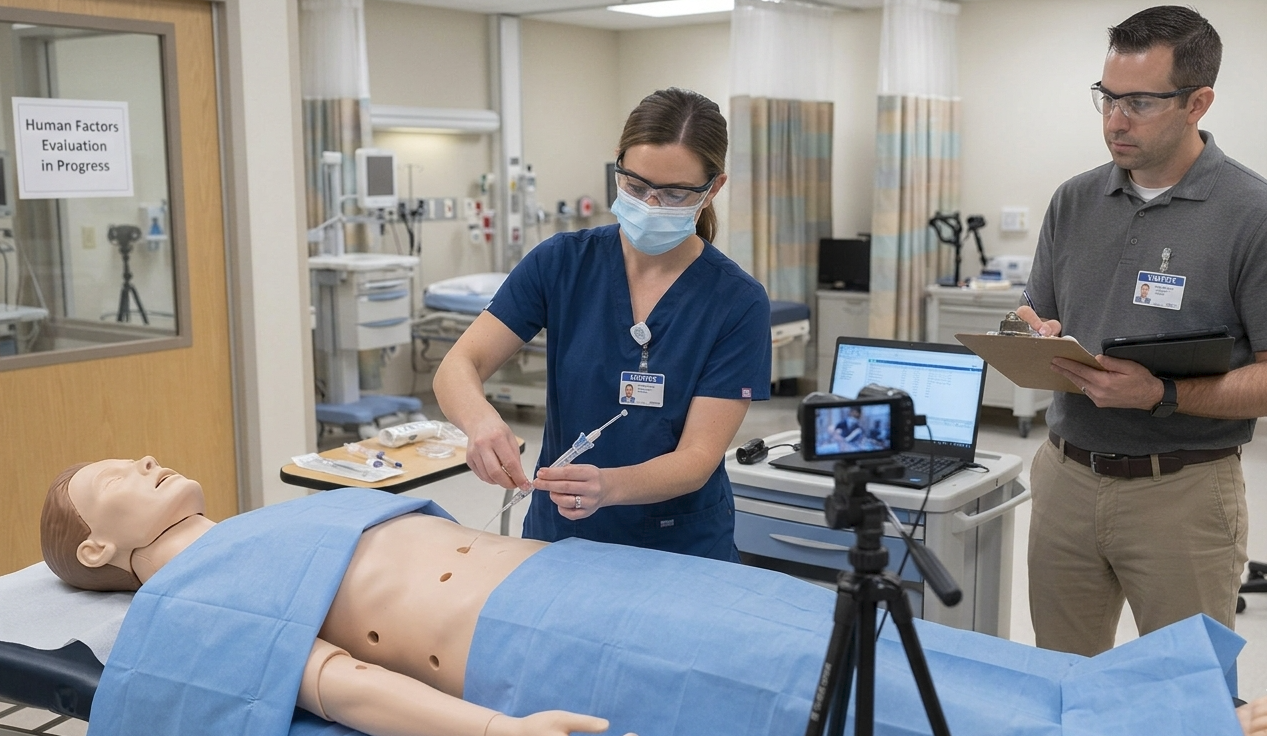
Ten years later … and we now have the final guidance document from the FDA, Applying Human Factors and Usability Engineering to Medical Devices. To set the tone, the word “risk” appears in it over 100 times. Not surprising to anyone who has been developing medical devices in the last 10 years, but human factors can quickly derail the most innovative technology, even sink a whole company. So, although the “risk” the FDA is concerned about is the risk to the patient, you won’t even make it to market if you don’t take human factors seriously from the beginning.
I could probably write a book about the number of times, as an engineer, I thought my device was so obviously easy to use, only to watch the nurse or surgeon do something crazy. Or when these reports come out about the FDA rejecting a device because the user couldn’t get the cap off or had trouble opening the package. I have to laugh, not because the FDA is rejecting it, or that the user couldn’t figure it out, but because behind every fail, is an epic Human Factors story I would love to hear. The device might work fine, might do amazing things, if only they could open the package! When this happens to me, it’s a classic “Don’t shoot the messenger" moment. It’s not the user’s fault. I take a deep breath and honestly thank them because now we can make it better. Every error they make in the beginning is one that just saved us a recall, one that can be mitigated before it hits the field.
The FDA recognized that use-related errors are a primary driver of adverse events and product recalls. For quality engineers, human factors specialists, and R&D engineers, human factors engineering (HFE) can no longer be an afterthought or a final verification checkbox. It is an essential part of the development process, anchored directly to risk management.
The Crucial Role of Risk Analysis in Human Factors Engineering
Human factors engineering is not merely industrial design, screen layout, or aesthetic polish; it is a systematic risk mitigation strategy. Both global standards ISO 62366 and FDA guidance require manufacturers to integrate usability engineering directly into the ISO 14971 risk management framework.
Risk analysis forms the engine of the HFE process. Rather than evaluating device hardware failures (such as a blown capacitor or cracked housing), a Use-Related Risk Analysis (URRA) evaluates human-device interactions. It maps out:
- User Task & Action: What the user is trying to accomplish, like setting a flow rate or responding to an alarm.
- Potential Use Error: How the interaction could go wrong
- Hazardous Situation & Harm: The clinical consequence of that error, like under / over-dose.
In many risk analysis methods, like FMECA, risk is a combination of Severity and Probability. However for Use-Related Risks, the FDA requires critical tasks be determined solely by Severity. Predicting the probability of a human error during early design phases is difficult and unreliable. If a potential use error could lead to serious harm or compromised medical care, the task associated with that error is considered a Critical Task. This requires additional risk controls and validation testing, regardless of how "unlikely" the error might seem.
What the FDA Expects in Usability Submissions
To obtain regulatory clearance or approval, manufacturers must demonstrate that the device’s user interface has been optimized to minimize use-related risks. The FDA expects a clear, well-documented Usability Engineering File containing specific core elements:
1. Comprehensive Use Specification
You must clearly define the intended user populations (e.g. specialized surgeons, lay caregivers), the intended operational environments (e.g. emergency rooms, transport vehicles, home settings), and the physical/software user interface touchpoints.
2. Identification of Known Problems and Past Failures
Regulatory reviewers expect you to study historical failures from predicate or similar devices. Reviewing adverse event databases and FDA recall histories before finalizing design specifications ensures your team incorporates hard-learned industry lessons into the design from the beginning.
3. Hazard-Related Use Scenarios and Critical Tasks
The FDA expects a clear decomposition of workflows into specific scenarios. Any scenario that contains steps where a use error could result in serious harm are designated as critical tasks.
4. Formative vs. Summative Evaluations
Usability cannot be validated in a single step at the end of development:
- Formative Evaluations: Iterative, small-scale usability tests conducted during preliminary design phases to evaluate user mental models, test interface prototypes, and refine risk controls.
- Summative (Human Factors Validation) Testing: A rigorous, final evaluation conducted under simulated real-world conditions with representative users to prove that the final device can be used safely and effectively without unacceptable residual risk.
5. Prioritization of Risk Controls
When mitigating use-related risks, the FDA and ISO 14971 enforce a strict hierarchy of controls:
- Inherent Safety by Design: Redesigning the user interface to make the error physically or logically impossible (e.g., unique mechanical connectors that prevent incorrect line attachment).
- Protective Measures: Incorporating software guards, hard stops, or intelligent alarms (e.g., dose-error reduction systems with upper and lower programming limits).
- Information for Safety: Providing warnings in labeling, user manuals, or on-screen prompts. The FDA explicitly cautions that relying solely on training or user manuals is the least effective mitigation strategy.
The Trap of Static Spreadsheets in Human Factors
Despite these stringent expectations, many engineering teams attempt to manage human factors data, task analyses, design requirements, and risk matrices across separate, static spreadsheets.
In complex medical device projects, this fragmented approach creates severe vulnerabilities where essential mitigations or verification activities can be missed.
- Broken Traceability Links: ISO 14971 and FDA 21 CFR 820.30 demand full bidirectional traceability. Connecting Critical Tasks to mitigations to Design Requirements and ultimately through to V&V testing. Linking all this together for dozens, even hundreds of tasks is just asking for errors.
- Orphaned Mitigations: Late-stage design changes often disconnect risk controls from their verification tests, leaving unmitigated hazards right before regulatory submission.
- Audit Vulnerabilities: Auditors look for inconsistencies between your URRA, Hazard Analysis, and Verification/Validation reports. Inconsistent terminology across separate files is an easy path to regulatory observations or submission holds.
Redpoint Reqs Streamlines Human Factors and Usability Engineering
Every time a regulatory submission approaches, I find myself sitting up night after night double and triple checking everything. Trying to make sure everything is accounted for and linked up correctly. I was always looking for a better way but could never find the tool I wanted or could afford. I built Redpoint Reqs to fill the gap between doing your best with Word and Excel, and the expensive enterprise level programs. Designed around ISO 14971 and FDA 21 CFR 820.30 design control workflows, Redpoint Reqs provides a single source of truth for your entire development team.
Unified Usability and Risk Architecture
Redpoint Reqs integrates Task Analysis / URRA, Hazard Analysis, and FMECA into the same system as your User Needs and Design Requirements. You can write user needs, identify critical tasks, and establish risk controls simultaneously, ensuring that every identified usability hazard traces directly to a testable requirement and validation protocol.
Integrated Real-World Intelligence (FDA Recalls)
Redpoint Reqs natively integrates FDA recall failure analysis into your engineering workflow. By analyzing historical recall data from similar devices during early-stage design, your team can catch hidden failure modes and high-risk use errors before locking down your design.
AI-Assisted Traceability and Compliance
Leverage built-in AI tools to propose mitigations, draft requirements and suggest traceability links across your risk and usability files.
Audit-Ready Visibility
Instant trace maps, dashboard analytics, and real-time collaboration allow engineering, quality, and regulatory teams to instantly assess compliance coverage and audit readiness. When an auditor asks how a critical usability task was controlled and validated, you can present an end-to-end trace matrix in seconds.
Build Safety into Your Design from Day One
Human factors engineering is not about getting a clean report in the end. It is not a step or a checkbox, it is a foundational pillar of the development process. Gone are the days that you build a prototype, do a couple of labs and then get your 510k approved. Human factors engineering needs to be fully integrated into your development process. By aligning your usability engineering process with FDA expectations and replacing a mess of fragmented documentation with a purpose-built tool to integrate it all you will reduce regulatory submission risk, pass audits with confidence, and bring safer, more intuitive medical devices to market faster.